
The development prospects of the disposable fully degradable starch tableware market
1 Market Overview
Disposable fully degradable starch tableware is a completely biodegradable environmentally friendly tableware made of starch as the main raw material (such as corn starch, tapioca starch, potato starch, etc.). Its degradation mechanism belongs to the category of biodegradation: after the tableware enters the environment, the starch in it is decomposed, digested and absorbed by microorganisms as nutrients, and finally enters the material circulation system of the natural biosphere. This type of tableware can be completely biodegradable after use, more than 90% in about 10 days, and can be completely degraded within a month, and can increase soil fertility.
The global biodegradable tableware market size is expected to grow from US$46.24 million in 2025 to US$96 million by 2034, at a compound annual growth rate (CAGR) of 8.45%. The Chinese market is particularly strong, and it is expected that by 2030, the market size of China’s fully degradable environmentally friendly tableware will reach 108 billion yuan, making it one of the largest markets in the world.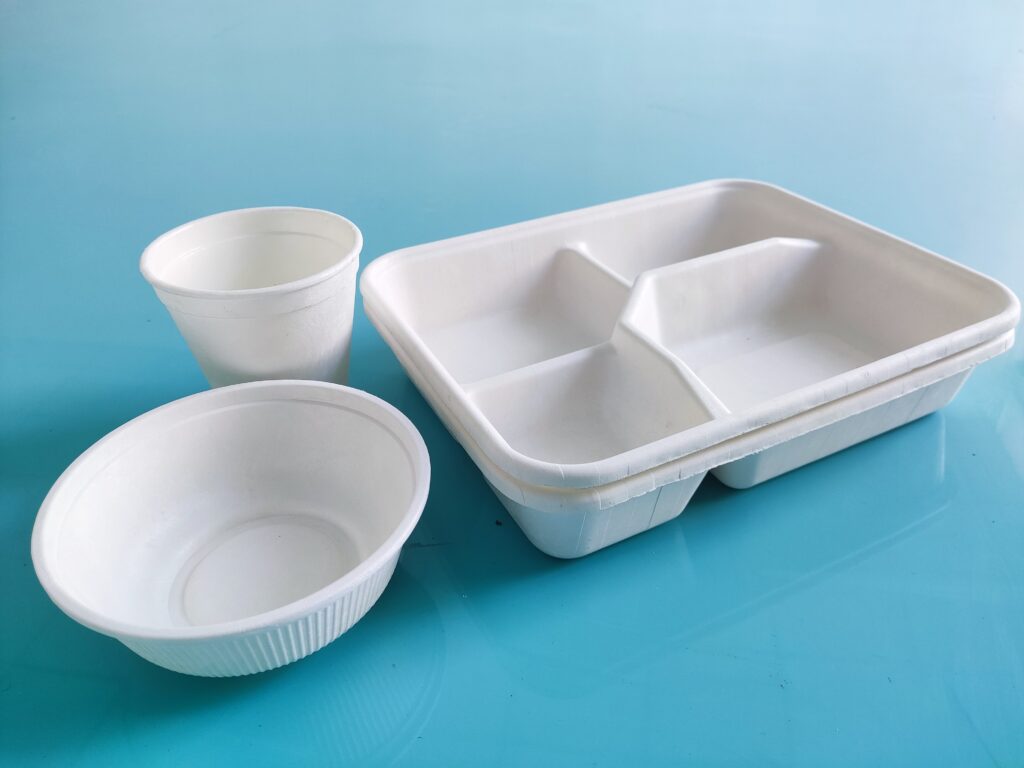
2 Market drivers
2.1 Promotion of policies and regulations
More than 120 countries and regions around the world have imposed restrictions or bans on single-use plastics. As early as 2000, China’s State Economic and Trade Commission listed disposable foam plastic tableware as a time-limited elimination product, and successively introduced relevant industrial support policies and financial support policies. These “plastic ban orders” and “plastic restriction orders” provide huge market space for fully degradable starch tableware.
2.2 Consumers’ awareness of environmental protection has increased
Global warming and environmental concerns are increasingly triggering increased public demand for renewable resources. According to the survey, in European and American countries, more than 65% of consumers are more inclined to choose biodegradable tableware in fast food restaurants, and about 47% of American consumers will actively choose biodegradable tableware in food delivery and catering services in 2024. In China, about 64% of food service customers actively choose restaurants that provide environmentally friendly tableware.
2.3 Corporate social responsibility and industry commitment
Large catering companies (such as Starbucks and McDonald’s) have committed to eliminating single-use plastics by 2030, and food delivery platforms (such as Meituan and Ele.me) are also adopting degradable packaging in large numbers, which together drive the market development.
3 Market challenges and risks
Despite the promising market prospects, the disposable fully degradable starch tableware industry also faces several challenges:
- Higher production costs: The production cost of biodegradable tableware is currently 35%-40% higher than traditional plastic tableware. Although starch raw materials are abundant and relatively inexpensive, production costs are still one of the obstacles to plastic alternatives.
- Product performance and durability issues: Some biodegradable tableware has a relatively low tolerance to high-heat food, and its durability is sometimes worse than that of traditional plastic tableware.
- Inadequate supply chain and recycling infrastructure: Globally, recycling and composting infrastructure is not yet complete. According to statistics, about 52% of biodegradable tableware waste is still mixed with ordinary plastic waste due to inadequate classification and recycling, reducing composting efficiency.
- Technology iteration and raw material dependence: There are certain technical risks in the industry, and manufacturers need to continue to innovate and accumulate. In addition, the supply stability of raw materials may also have an impact on production.
4 Competitive landscape
The global biodegradable tableware market is driven by a mix of small and medium-sized enterprises and multinational corporations. Among them, polylactic acid (PLA) tableware accounted for the largest market share (49%), followed by crystalline polylactic acid (CPLA) with 32%, and eco-friendly options such as bamboo and wood accounted for 19%. The Chinese market is dominated by large domestic and foreign manufacturers, as well as small and medium-sized enterprises seeking differentiated competition in segments, and entrepreneurial companies focusing on innovative materials and technologies. In terms of competitive strategy, price wars still exist in the short term, but brand building and product quality are increasingly becoming the key to long-term competitive advantage.
5 Technology development and cost analysis
The technology of starch-based tableware is constantly advancing. By adding natural fiber reinforcement strength, using extrusion technology to reduce weight, and surface spraying and shaping, the product has good waterproof, oil-proof, and heat-resistant properties. Its performance indicators have reached or exceeded national standards and obtained a number of national patents.
6 Future trends and prospects
In the next few years, the disposable fully degradable starch tableware market will show the following trends:
- Technological innovation and cost reduction: With the advancement of material science and production processes, such as exploring the application of more renewable resources (starch-based, cellulose-based) and improving production processes, production costs are expected to be further reduced and product performance will continue to improve.
- Continuous expansion of application scenarios: From the catering industry and takeaway delivery to home use, agriculture and other fields. In particular, demand in the takeaway market (such as Meituan and Ele.me), fast food restaurants, school canteens, government canteens, aviation catering and other fields will continue to grow.
- Continued policy support: Governments are expected to continue introducing policies to support the development of eco-friendly industries, including subsidies, tax incentives, and stricter restrictions on single-use plastics, providing long-term impetus to the market.
- Increased consumer acceptance: With the popularization of the concept of “green consumption” and the enhancement of consumer awareness of environmental protection, the demand for fully degradable products will continue to rise.
- Industrial chain integration and closed-loop management: From raw material planting to waste recycling, forming a closed-loop management of the whole chain to reduce resource waste and environmental pollution will become the development direction of the industry.
Conclusions and recommendations
The disposable fully degradable starch tableware market has broad future development prospects, especially in the Chinese market, driven by the global wave of “plastic ban”, policy support and improved consumer environmental awareness. However, the industry still needs to deal with challenges such as cost control, technological innovation, and improved recycling infrastructure. For potential investors and businesses, it is recommended to:
- Focus on technological innovation to improve product performance (such as heat resistance, durability) and reduce production costs.
- Pay attention to policy trends and actively use government subsidies and tax incentives and other support policies.
- Strengthen consumer education to enhance brand image and market awareness.
- Optimize supply chain management to ensure the stable supply of raw materials and the sustainability of the production process.
- Explore in-depth cooperation with downstream enterprises such as catering and takeaway to jointly develop the market. Overall, disposable fully degradable starch tableware, as an important alternative to traditional plastic tableware, will play an important role in reducing white pollution and promoting circular economy, with significant social and economic benefits.